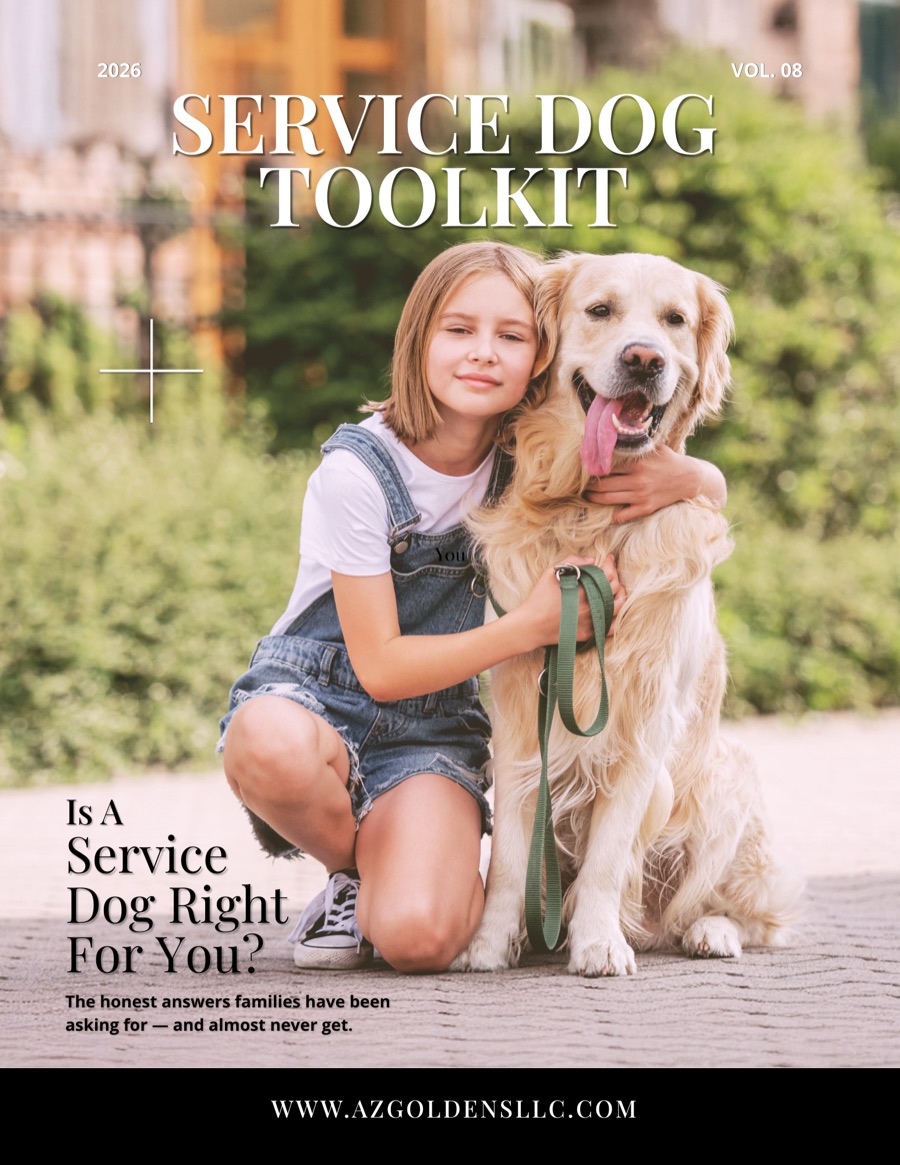
Premier Program
For handlers whose custom task set needs professional building end to end, on a dog selected for the specific work.
Learn moreOther Unique Disabilities · Custom Programs
Some conditions come with a program waiting for them. Yours might not — a rare diagnosis, an unusual combination, a set of challenges no brochure mentions. This is the program for exactly that: task work designed from scratch around your actual life, on the same training architecture that runs everything else we do.
Arizona-based · Serving handlers nationwide
Some conditions come with a program waiting for them. Yours might not. We design the task work from scratch — around your actual day, on architecture that already works.
We hear you
If your condition is rare, you know the routine by heart: the spelling-it-out, the blank looks, the programs whose intake forms don't have a box for you. The service dog industry mostly organizes itself around a short list of diagnoses — and quietly says no to everything else, not because a dog couldn't help, but because there's no pre-built program to sell you.
We've spent close to thirty years watching conditions arrive that had no category yet. Some of our published programs began exactly this way — as one family's 'unusual' need that we built tasks for, tested, refined, and eventually made a track of its own.
So this page makes the offer plainly: bring us the actual challenges — the moments in your day that need a trained intervention — and we'll tell you honestly whether task work can be designed for them. Diagnosis names matter less here than what actually happens, and what a dog could reliably be trained to do about it.
The method, step by step
For unique conditions the honest product isn't a task menu — it's a design method. This is the one we run, and it's the same discipline underneath every published program we offer.
We start with your day, not your diagnosis: the specific recurring moments where something goes wrong, gets dangerous, or costs you independence. Each becomes a design target with a plain description — what happens, what warning exists, what would help, who's nearby. This inventory, not the condition's name, is what the program gets built from.
Dogs have a real, bounded set of trainable capabilities — recognition of physical patterns, trained responses, retrieval, pressure, interruption, get-help chains, physical support. Each of your moments gets matched against that set honestly, and sorted: clearly trainable, worth testing, or beyond what a dog can reliably do. The third category gets said out loud.
Almost no custom task starts from zero. The recognition-and-response chain from our medical work, the interruption and grounding work from psychiatric training, the retrieval and brace mechanics from mobility — your program gets assembled from components that already work, adapted to your specifics, rather than invented on hope.
Custom tasks get trained to the same standard as catalog ones: built link by link, tested against distraction and real conditions, demonstrated before the dog is yours. 'Custom' never means 'experimental at your expense' — anything we can't train to reliability doesn't ship as a task.
A custom program meets reality after placement — and reality always has notes. The coaching relationship carries the refinement: tasks tightened around how your condition actually behaves, additions as needs emerge, the working repertoire kept honest against your real days rather than the design document.
Why we can say yes
Every established service dog category was once somebody's unusual request. The industry's short menu isn't a law of nature — it's a business choice, and programs that only sell pre-built tracks have to say no to everyone the tracks don't fit.
Our history runs the other way: we've been building disability-specific task work since 1996, we've placed dogs with handlers from 18 months old into their eighties, and several of the programs on our own shelf began as custom builds for a condition nobody had a track for.
None of that makes every condition trainable — it makes the evaluation honest. The same experience that lets us design new task work is what lets us recognize, early and plainly, when a dog isn't the right tool.
How to vet any program — including usGetting started
The same four steps as every program — the custom design work happens inside the assessment, where it belongs. Each step links straight to where it happens.
Phone or Zoom with an experienced Service Dog Coach. Bring every question you have — including the hard ones.
Book your free call →An in-depth evaluation of disability profile, lifestyle, and needs — breed, temperament, drive level, tasks, and program fit. Every training plan starts here.
Start the assessment →A trainer and a dog-in-training come to you for a 90-minute working session — we evaluate the fit, you experience the methodology. Required for Premier.
How the visit works →The Service Dog School can start immediately — no waitlist. Premier and Foundations begin as your match comes together.
See the programs →Proof, not promises
The strongest evidence for custom work is structural: the design method here is the same one running underneath every published program on this site — the response chains, the interruption work, the retrieval and support mechanics — applied to a new target. Close to thirty years of task training, handlers from toddlers to seniors, and categories on our shelf that began as one family's unprecedented request. Your condition being rare doesn't make the method unproven; it makes you the next application of it.
The math on waiting
Another year of hearing that your condition doesn't fit anyone's intake form is a year nobody spends building the thing that would actually help.
Worth knowing: our pre-trained dogs are almost always spoken for, so most handlers' dogs are raised for them — about 12 to 14 months of training that starts the day you commit. The toolkit is free and takes two minutes.
Straight answers
The honest answer requires the conversation the others wouldn't have: what actually happens in your hard moments, what warning signs exist, and what intervention would genuinely help. Some conditions map beautifully onto trainable work; some don't; most land in between, with a subset of challenges a dog can reliably cover. That mapping is exactly what our assessment does — and it ends in a straight answer either way.
Custom task design is how several of our established programs began — a need without a category, built into task work, refined into a track. You'd be a new application of a method we've run for decades, not a test subject: every custom task is assembled from proven training components and built to the same reliability standard as anything on the shelf. What we can't build to reliability, we don't ship.
The same four steps as everyone else, with the assessment doing heavier lifting: your challenge inventory gets mapped against trainable capabilities, the candidate task set gets designed and sorted — clearly trainable, worth testing, honestly out of reach — and the training plan gets built from there. You see the design before anything is committed, and the finished tasks demonstrated before the dog is yours.
Neither — that's the point of this program. The design method doesn't care which chapter of a textbook your challenges come from; it maps moments to trainable interventions, and freely mixes components from the medical, psychiatric, and mobility architectures when your life needs all three. Complex mixes are closer to our normal than you'd guess.
Then you'll get it plainly, at the evaluation — along with our best thinking on what would help instead, whether that's technology, a different kind of support, or simply the truth that presence-comfort doesn't require a task-trained service dog. An honest 'no' early is a better outcome than a dog that can't do the job.
Keep reading
More coming for this program
Free · 2 minutes · Built for your situation
Twenty minutes, no pressure, and an honest read on whether task work can be designed for your situation. The free call is where every custom program has ever started.
Three ways in
Custom programs run on the same three paths — with the design work weighted toward wherever the professional training happens.
For handlers whose custom task set needs professional building end to end, on a dog selected for the specific work.
Learn moreFor handlers who want the custom foundation designed and built professionally, then finished together with coaching.
Learn moreFor hands-on handlers whose custom needs sit within trainable reach of a dedicated owner — with the design method and coaching behind you.
Learn more