
Premier Program
For handlers who need the dog working from day one — and for successor-dog handlers who know exactly what a trained partner is worth.
Learn morePsychiatric & PTSD Service Dogs · Since 2006
If your world has been getting smaller — the store you avoid, the line you can't stand in, the sleep that doesn't come — a task-trained dog is a way back. We were among the first in the U.S. to develop true task training for psychiatric conditions, including deep pressure therapy and behavioral interruption, back when most programs were placing companions and calling it done.
Arizona-based · Serving handlers nationwide
Most people who call us have already done the work — therapy, medication, years of it. We train service dogs for the moments clinical care can't be in the room for.
We hear you
Most of the people who call us about psychiatric work have already done everything they were told to do. Therapy, sometimes years of it. Medication that helps but doesn't finish the job. And still the hypervigilance runs the calendar — deciding which stores are possible, which seats are acceptable, which invitations get declined.
A lot of them are veterans. Some are people whose panic attacks keep landing them in emergency rooms, being told there's nothing wrong. Almost all of them have researched this for months before picking up the phone, and they ask sharper questions than anyone — including the one we respect most: how do you treat your dogs?
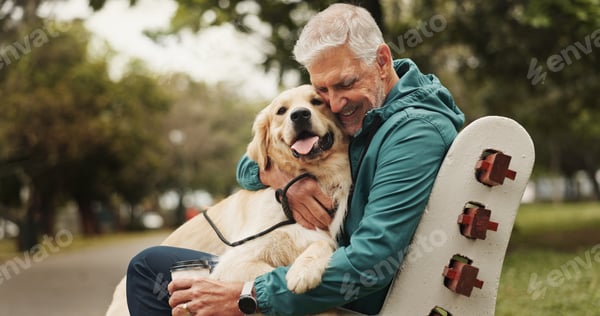
A psychiatric service dog doesn't replace any of the clinical work. It's a working partner trained to catch what your nervous system does before you've consciously noticed it — and to interrupt, ground, and guard so that public life stops costing what it costs now.
The work, task by task
These come straight from our psychiatric training manuals — the tasks we actually train, ranked by what handlers need first. Read them as possibilities, not a checklist: a combat veteran, someone with severe OCD, and a college student with panic disorder each need a different build.
Episodes build before you consciously notice them — breathing shallows, posture shifts, thoughts start to race. The dog is trained to catch those early physical signals and interrupt: a nose nudge, a paw, focused contact that pulls your attention out of the spiral. When the episode is bigger than a nudge, the interruption flows straight into grounding — deep, sustained pressure that anchors you through the peak. Caught early, an episode that used to take an hour can resolve in minutes.
For a nervous system that runs a constant threat scan, being approached from behind is the trigger that can hijack a whole day. On the Cover command — many handlers know it as Watch My Six — the dog positions behind you, facing rearward, and alerts with a nudge or body shift when someone enters your buffer. That fraction of a second turns being snuck up on into a calm, controlled turn.
Checkout lines, waiting rooms, transit platforms — the places where closeness reads as threat. On command, the dog places its body between you and the nearest press of people, holding a boundary most strangers instinctively respect. A few feet of guaranteed personal space, in exactly the environments that never offer any.
The dog sleeps in your room and learns your distress signature — the breathing change, the thrashing, the calling out — and intervenes to wake you gently before the nightmare runs its full course. Between episodes, the dog's steady breathing and warm weight give your nervous system something to anchor to. Many handlers sleep through more nights; on the nights they don't, the nightmare gets caught early instead of running to the end.
Checking the lock the twentieth time, washing until skin is raw, picking, pulling — loops that are almost impossible to break from inside. The dog is trained on your specific pattern and interrupts it: a paw on the hand, a body between you and the thing being repeated, and then a healthier outlet to redirect into. The urge doesn't vanish. The exit from it is standing right there.
Before you commit to anything
Ask how we train. You'll hear it plainly: positive reinforcement, relationship-based work, and never — under any circumstances — shock collars or fear-based methods. If you've read enough about this industry to be wary, good. You should be. Ask every program the same question and listen to how fast they answer.
Ask whether this is the right time. A dog is a daily responsibility, and if you're in the middle of the worst of it, we may tell you to stabilize with your clinical team first and come back — because placing a dog into a crisis helps no one, least of all the dog. Not yet isn't not ever, and saying it honestly protects the partnership you'll eventually build.
And ask what happens if the match isn't right. Temperament matching is half this work — a high-energy dog paired with an overloaded nervous system fails both of them. It's what the assessment and the in-home interview exist to prevent.
How to vet any program — including usGetting started
No sales pitch, no obligation. We'd rather educate you than sell you — this is a working session from the first call. Each step links straight to where it happens.
Phone or Zoom with an experienced Service Dog Coach. Bring every question you have — including the hard ones.
Book your free call →An in-depth evaluation of disability profile, lifestyle, and needs — breed, temperament, drive level, tasks, and program fit. Every training plan starts here.
Start the assessment →A trainer and a dog-in-training come to you for a 90-minute working session — we evaluate the fit, you experience the methodology. Required for Premier.
How the visit works →The Service Dog School can start immediately — no waitlist. Premier and Foundations begin as your match comes together.
See the programs →Proof, not promises
“Having served two tours in Iraq, PTSD finally caught up with me. My service dog from Arizona Goldens is a friend, companion, and life saver. The team helped me reclaim my life.”
Dan M. · U.S. Army veteran · AZG placement
The research backs the lived experience: the largest NIH-funded study of PTSD service dogs to date (2024) found veterans partnered with a trained dog fared meaningfully better than those still waiting — less severe symptoms, more of life back. The same research is equally clear that the dog works alongside clinical treatment, not instead of it. That's our experience too, and it's how we'll talk to you about it.
The math on waiting
Another year of the smaller world — the store you skip, the seat you have to have, the sleep that keeps not coming — costs something real. It just never arrives as a bill.
Worth knowing: our pre-trained dogs are almost always spoken for, so most handlers' dogs are raised for them — about 12 to 14 months of training that starts the day you commit. The toolkit is free and takes two minutes.
Straight answers
Alongside, not instead. The dog handles the moments clinical care can't be present for — the panic spiral in aisle nine, the person walking up behind you, the 3 a.m. nightmare. When the dog is covering the nights and the doorways, the clinical work has more to work with. Bring your care team's questions to the free call — referrals from therapists and clinicians are how many of our handlers found us.
Here's the honest version: the dog doesn't read your mind — it reads your body. Breathing changes, posture shifts, the small movements that precede an episode happen before you're consciously aware, and a dog trained on your specific pattern catches them early — which is the whole game, because early interruption is what keeps a spiral from becoming an episode. What no honest trainer will promise is prediction of every episode, every time.
At home — which is where it should start anyway. The early work is about the bond and the baseline: the dog learning your patterns, you learning the handling. Public work builds outward from your front door at the pace your nervous system allows, from quiet parking lots up through the grocery store. The destination is public life; the route respects where you're starting from.
Positive reinforcement and relationship-based methods, exclusively — no shock collars, no fear-based training, ever. A psychiatric service dog has to be a safe haven for a dysregulated nervous system; a dog trained through intimidation can't be that. If you visit, you'll watch the methodology work in front of you.
We'll be straight with you, because this is where a lot of programs aren't: the VA does not pay for the dog or its training today. What we can do is what we do for every handler — walk your real funding options honestly on a free call, including community and veteran-organization support that has come through for our military families before.
A task-trained service dog has public access rights under the ADA — stores, restaurants, transit, workplaces with narrow exceptions. Our training includes the public-access work and certification prep, and every dog is trained to be invisible in public until it's needed: parked under the table, watching your six, working. The vest doesn't make the dog legitimate. The training does.
Keep reading
More coming for this program
Free · 2 minutes · Built for your situation
Two minutes of questions, a toolkit built around psychiatric work, and no sales pitch — ever. Read it, then decide if we're worth a phone call.
Three ways in
Handlers come to psychiatric work from different places — some need a finished dog, some need the work itself. All three paths end the same way: a task-trained partner and a handler who knows how to use one.
For handlers who need the dog working from day one — and for successor-dog handlers who know exactly what a trained partner is worth.
Learn moreFor handlers who want the foundation built professionally, then to finish the training themselves with coaching — for many, the daily work becomes part of the recovery.
Learn moreFor hands-on handlers who want to train their own dog with our system and coaches behind them — for many, the structure of the daily work is part of what helps.
Learn more