


Back to home

Autism Service Dogs · Since 2006

A Trained Partner for the Moments You Can’t Be Everywhere.

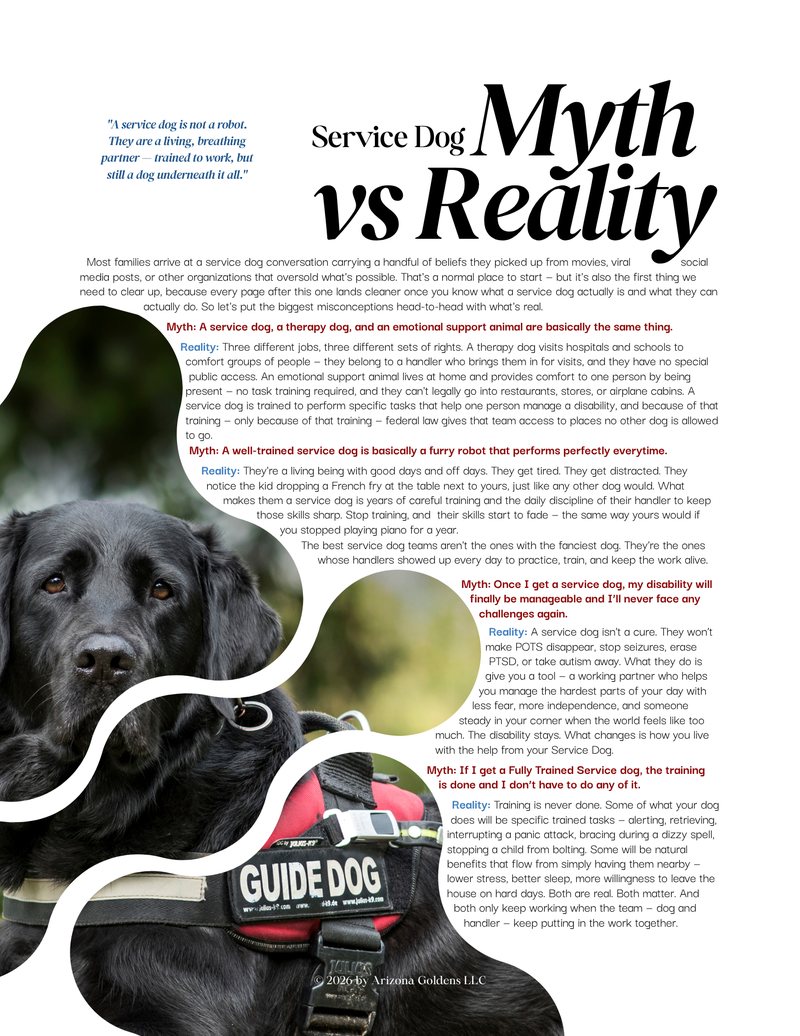
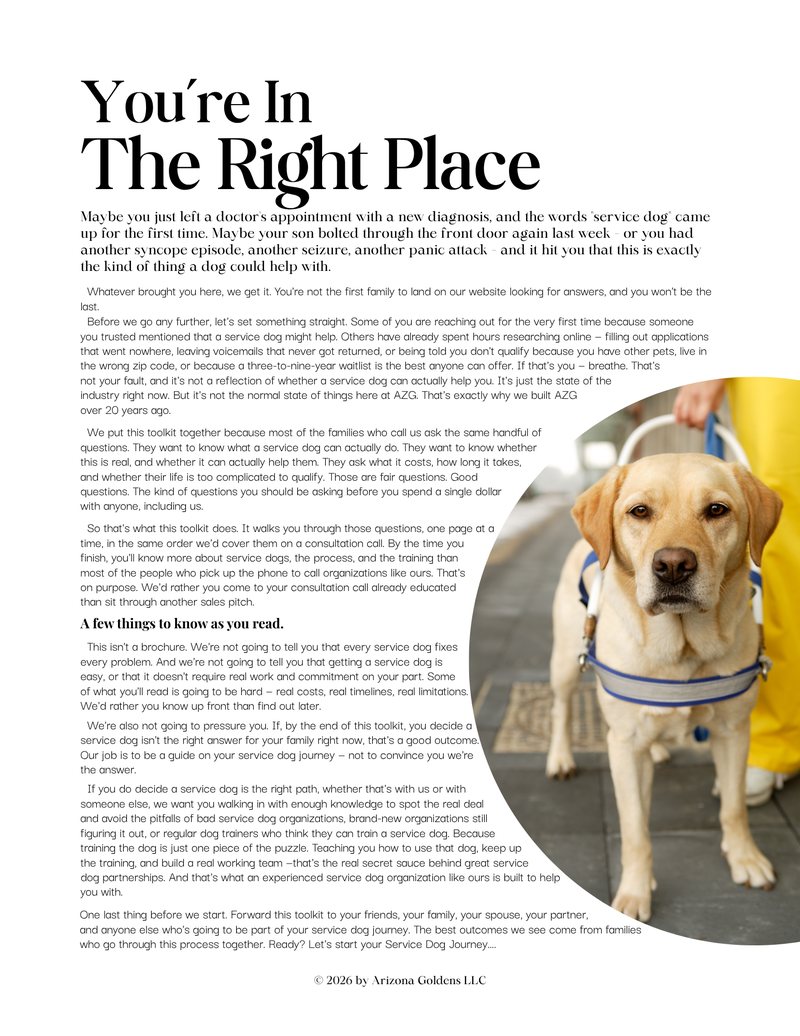
An autism service dog is a tool to help overcome the daily challenges that come with autism — and a friend when no one else is. This is a task-trained partner — anchoring, meltdown interruption, deep pressure, help sleeping at night — built for your specific child by the program that was among the very first in the U.S. to do this work.

Most autism parents live on high alert. We train service dogs that can be your second set of eyes — so your child is safer, and your family finally gets to breathe.

We hear you

You're Not the First Family to Tell Us This Story

Most families who call us tell a version of the same story. Their child started eloping — out the front door, across the parking lot, straight toward the street — and every outing became a two-person security operation. Or the meltdowns outgrew the strategies. Or nobody in the house has truly slept in years.

By the time they reach us, they've usually tried a lot. Therapies. Accommodations. Alarms on the doors — for some families, a tent over the crib. Some of it helped. None of it lets anyone breathe.

A trained autism service dog doesn't replace what you've built — the therapies, the IEP, the routines that work. It adds the one thing none of them can: a working partner with four feet on the ground next to your child, trained for the exact moments you can't be everywhere at once.

Service Dogs for Autism — open on YouTube ↗
  • She runs — straight for the street.
  • I can't watch him every second in a store.
  • We can't be there all the time.
  • I don't want another device. I want something trained to her.

The work, task by task

The Five Tasks Autism Families Ask For Most

These come straight from our autism training manuals — the tasks we actually train, ranked by what families need first. Read them as possibilities, not a checklist: every child is different, and every dog is trained to yours. And these five are only the start — the full range of autism-specific tasks is mapped in our Disability Specific Needs Assessment, where your child's own task list takes shape.

  1. Bolting Prevention & Anchoring

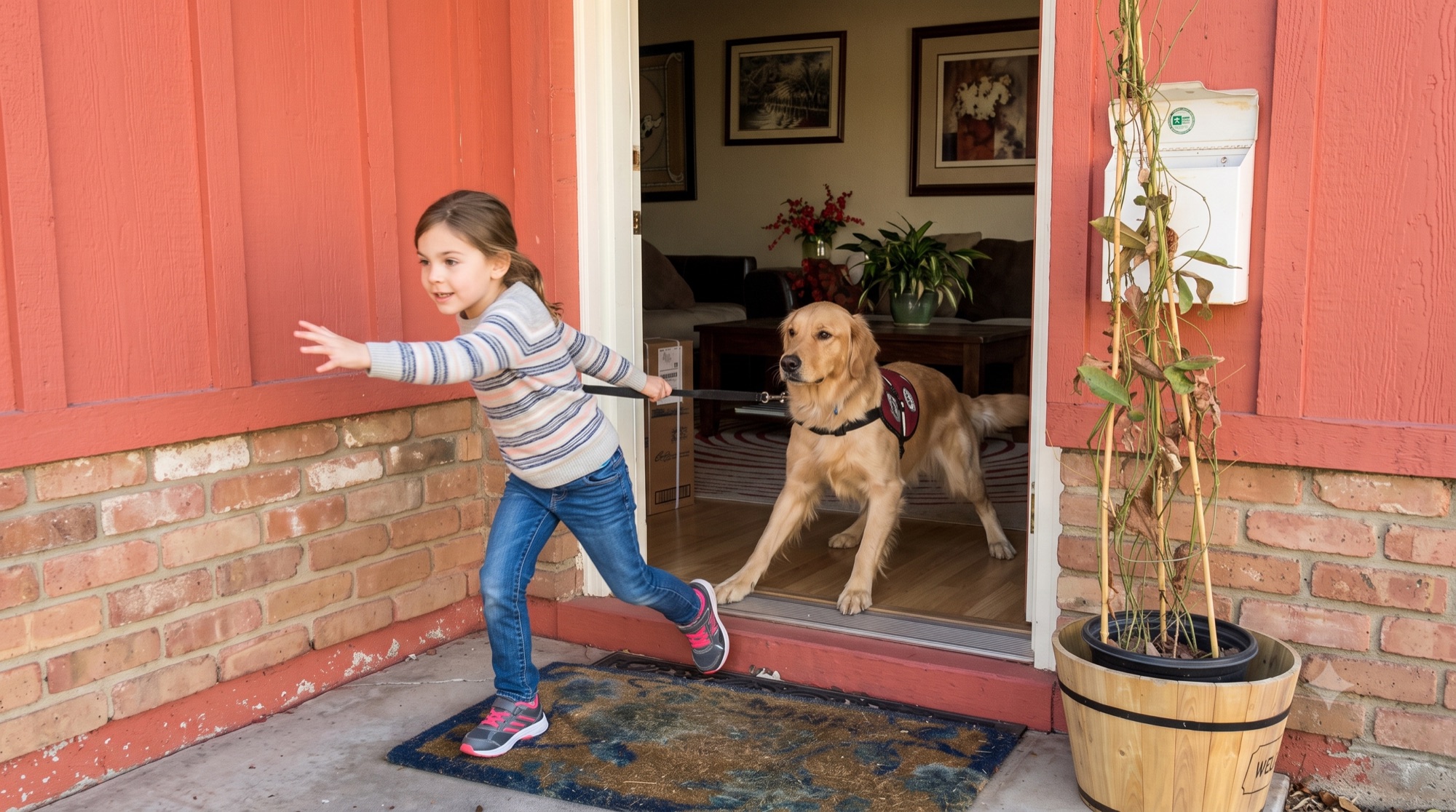
    When a child starts to bolt, the dog first slows their forward movement, then shifts into a full anchor — bracing in place, resisting pulling, ignoring the child's commands to move, and holding position until the adult handler gives the release. That discipline to hold the line is what makes this task genuinely lifesaving in a parking lot or at a busy intersection.

    A young girl darting out the front door while her golden retriever service dog braces against the leash in the doorway
  2. Meltdown Interruption & Recovery

    The dog learns to recognize the early signs of an approaching meltdown — rising voice, rapid movement, restlessness — and steps in before the peak: a gentle nudge to refocus, deep pressure, a body placed between your child and the trigger, or leading them out of the environment when that's the right call. Afterward, the dog stays through recovery, helping your child reset faster than they could alone.

    A white golden retriever staying calmly beside an upset young girl on her bed
  3. Deep Pressure Therapy

    On command, the dog applies steady, grounding weight across the lap, chest, or legs. Sustained pressure like this activates the body's natural calming response — the same principle as a weighted blanket, except this one breathes, adjusts, and loves your child back. We train multiple positions so the right pressure is there for the right moment.

    A dog lying across a resting girl's back, applying gentle steady pressure
  4. Interrupting Self-Injury & Redirecting Stims

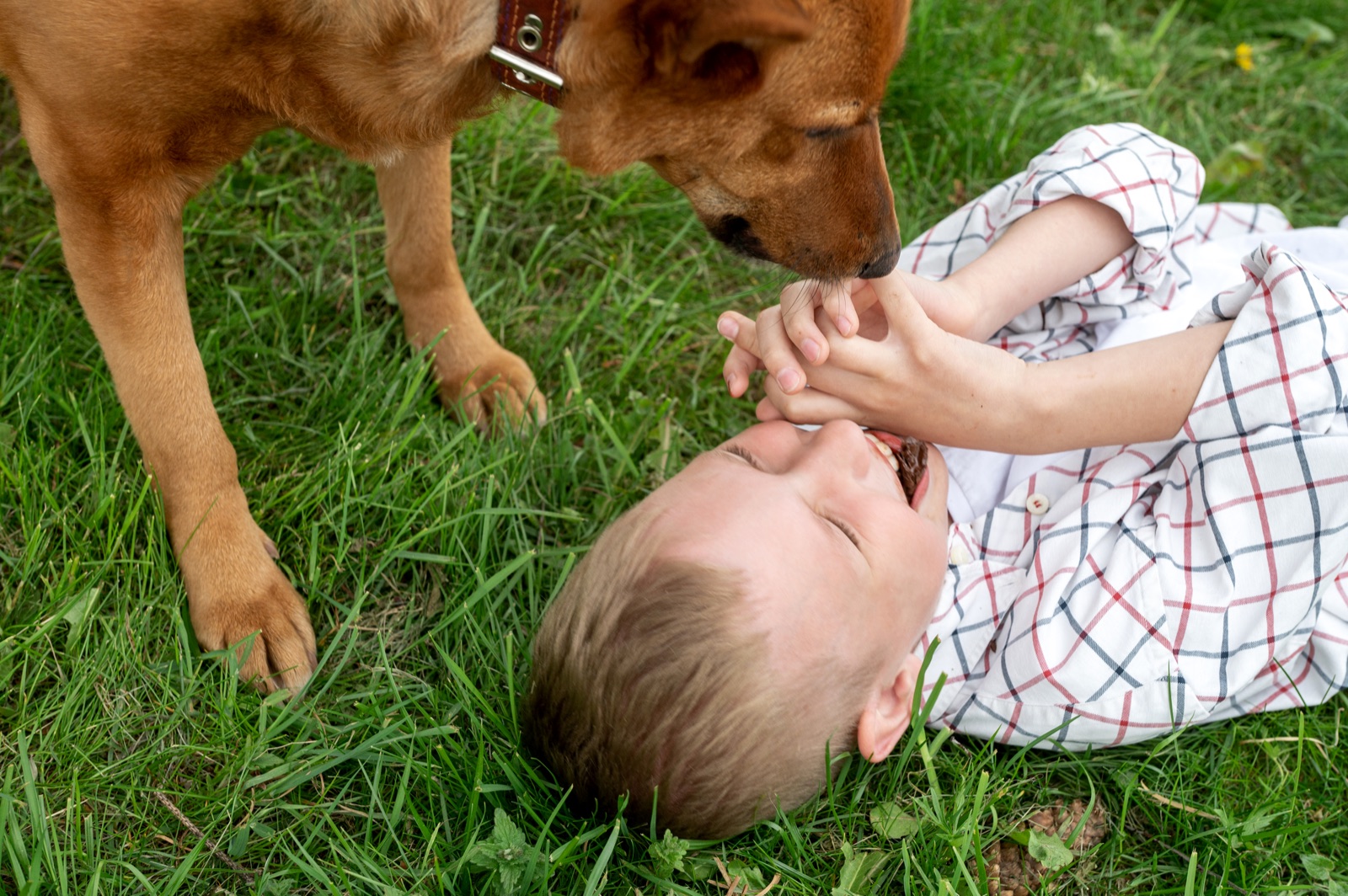
    The dog is trained to recognize your child's specific patterns — head-banging, biting, repetitive hitting — and interrupt them with a nudge, a paw, or a redirection. Stimming serves a real purpose for a child on the spectrum, so we don't just take it away. The dog becomes the safer self-soothing outlet your child reaches for instead: petting, brushing, a structured interaction that regulates the same nervous system.

    A dog gently nuzzling a boy's hands in the grass, redirecting him into petting
  5. Sleep & Nighttime Support

    When a child on the spectrum doesn't sleep, nobody sleeps. The dog's rhythmic breathing, steady heartbeat, and warm weight give your child's nervous system something to anchor onto — often enough to replace a parent's presence in the room. The dog can also be trained to respond when your child wakes restless, and to alert you if they leave their room at night.

    A young girl sound asleep with her arm around a golden retriever beside her in bed

Getting started

The Four Steps Out of Survival Mode

No sales pitch, no obligation. We'd rather educate you than sell you — this is a working session from the first call. Each step links straight to where it happens.

  1. Free 20-Minute Consultation

    Phone or Zoom with an experienced Service Dog Coach. Bring every question you have — including the hard ones.

    Book your free call →
  2. Comprehensive Assessment

    An in-depth evaluation of disability profile, lifestyle, and needs — breed, temperament, drive level, tasks, and program fit. Every training plan starts here.

    Start the assessment →
  3. In-Home Interview

    A trainer and a dog-in-training come to you for a 90-minute working session — we evaluate the fit, you experience the methodology. Required for Premier.

    How the visit works →
  4. Choose Your Program & Begin

    The Service Dog School can start immediately — no waitlist. Premier and Foundations begin as your match comes together.

    See the programs →

Proof, not promises

What Families Tell Us Changed…

“Over the almost seven years we've done multiple therapies, biomedical, multiple different interventions — and I would say this is the one that gives me the most hope for Luke's independent future.”

RoxanneMother of an AZG placement

The math on waiting

The One Cost Nobody Prices

Another year of the current normal — the two-person outings, the interrupted nights, the watching — has a price too. It just never shows up on an invoice.

And a fact worth knowing: our pre-trained dogs are almost always spoken for, so most families’ dogs are raised for them — about 12 to 14 months of training that starts the day you commit. The toolkit is free and takes two minutes. The clock on a trained dog only starts when you do.

Prefer to talk first? (480) 205-6810

Independent research

What the Studies Actually Show

The tasks on this page — the anchoring, the pressure work, the nighttime support — come from what we've watched work across thirty years of placements. It's fair to ask whether that holds up outside our own experience, so here is the independent research on autism service dogs: what it found, and where it found less than the marketing in this industry claims.

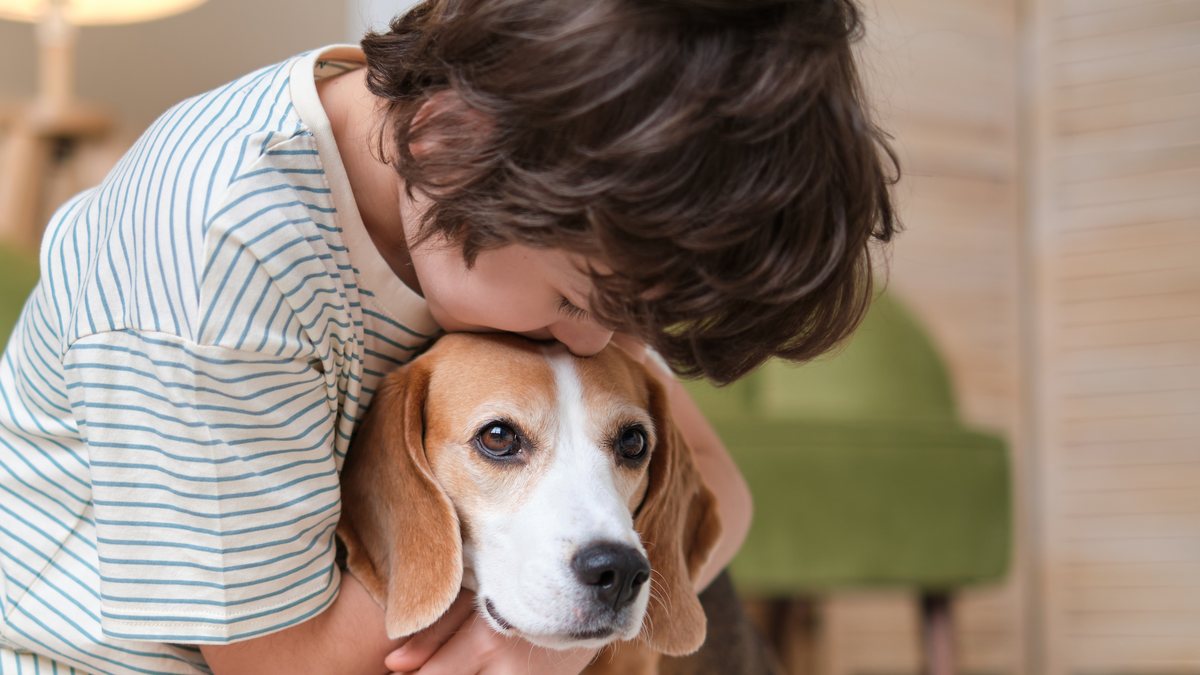
A boy leaning down to kiss his beagle on the head at home

Lower stress hormones in autistic children

Researchers measured the stress hormone cortisol in autistic children across three stages: before a service dog arrived, while the dog lived with the family, and after it was taken away. The children's morning stress surge dropped sharply once the dog moved in — and climbed straight back to its original level after the dog left. The effect tracked the dog.

Read the research
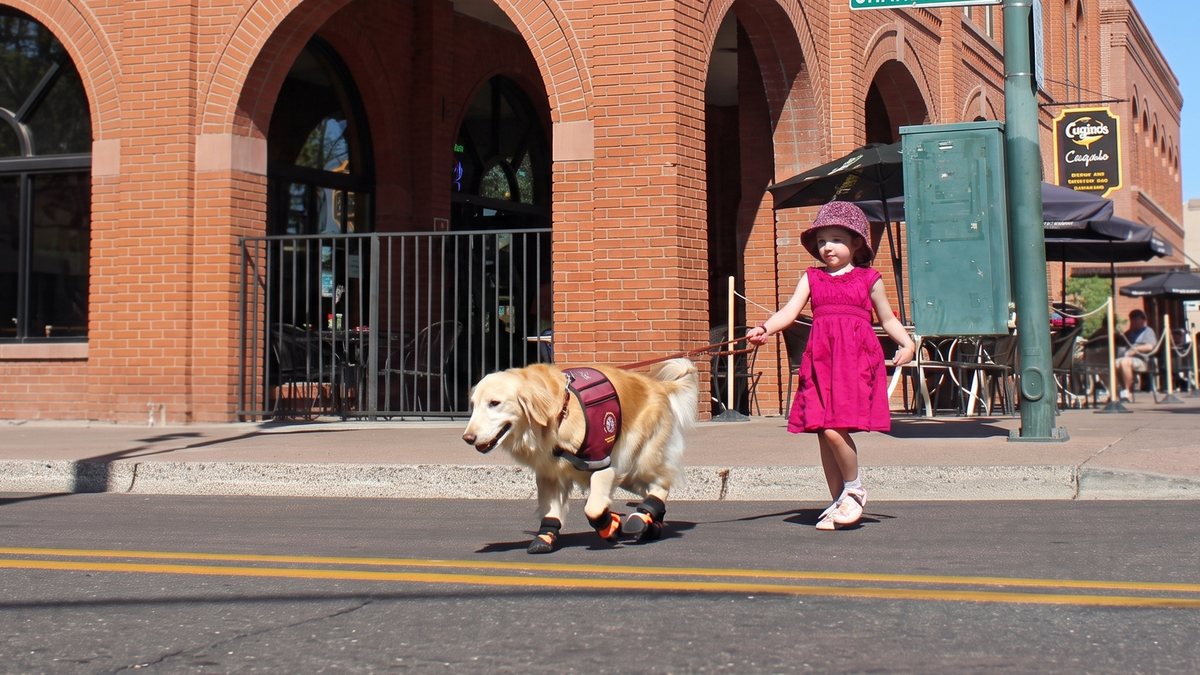
A little girl in a pink dress walking her vested golden retriever service dog across a downtown street

Parents report safety and competence

In a survey of parents raising autistic children, those with an assistance dog reported feeling more competent as caregivers and safer about the environmental dangers that keep autism parents awake. Notably, the study did not find lower overall caregiver strain — a working dog changes what your day contains, but it is still daily work.

Read the research
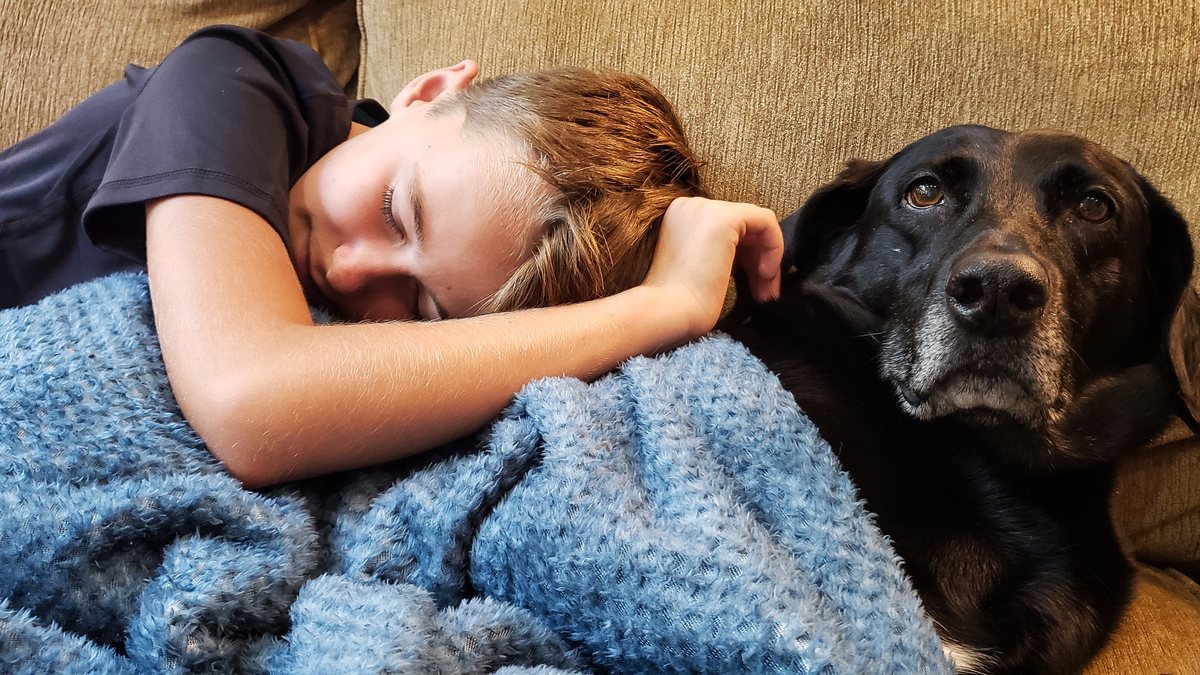
A boy asleep on the sofa under a blanket with a black dog resting beside him

Sleep improves — and the honest limits

This 2024 study compared 39 families who had a service dog with 36 still waiting for one. Children with dogs fell asleep more easily, slept longer, and needed less co-sleeping — a solid, measurable effect. Other measures, including irritability, peer relationships, and caregiver strain, showed no significant difference. Sleep is where the evidence is strongest, and it happens to be the outcome families ask us about most.

Read the research

Straight answers

The Questions Autism Families Actually Ask

How old does my child need to be for a service dog?

We've placed service dogs with children as young as 18 months old. There's no magic age — what matters is fit: your child's sensory profile, the severity and shape of the challenges, and your family's capacity. That's exactly what the assessment and home interview are for.

Will a service dog stop my child from running off?

This is the task we're asked about most, so here's the honest version. The dog is trained to slow a bolting child, then anchor — bracing in place and holding against pulling until the adult gives the release. It's a trained safety net built for exactly the places that scare you most — parking lots, intersections, front doors. It is not a guarantee, and it never replaces adult supervision. Any program that promises 100% elopement prevention is telling you what you want to hear.

We already have pets — and one of our kids is scared of dogs. Is that a problem?

Other pets are welcome here. Unlike programs that require you to rehome animals or bar homes that have them, we match and train with your whole household in mind — cats, older dogs, and a sibling who needs the dog to keep a gentle distance. That's part of what the in-home interview evaluates.

We can't take on a puppy. Does that rule us out?

No — it points you at the right program. Premier exists for exactly this: the dog is raised and trained before it joins your family, so what arrives is a working partner, not a project. If your child is older and would benefit from being part of the training — some kids bond deepest that way — Foundations and the Service Dog School put you inside the process with our coaches behind you.

Will the dog bond with my child, or with me?

Both — by design, and in different roles. For a young child, the parent is the working handler: you give the commands, the dog executes them, and your child is the person the dog watches, anchors, and settles against. The matching process weighs your child's sensory profile and energy against each dog's temperament, and the training is built around your specific child — their patterns, their triggers, their name. The bond you're worried about transferring is the thing the whole process is engineered to build.

What actually happens during a meltdown in public?

The dog works, and you stay the parent. Trained interventions run from a nudge that breaks the spiral, to deep pressure across your child's lap, to the dog physically placing itself between your child and whatever set them off — and when the environment itself is the trigger, leading your child out of it. Your job stays what it's always been: reading your child and directing the dog. What changes is that you're no longer doing it with your hands full and your heart in your throat.

Can the dog go to school with my child?

Public access under the ADA covers stores, restaurants, and most public places. Schools are their own conversation — access runs through the school and your child's IEP or 504 plan, and policies vary by district. We help families prepare the training documentation and public-access credentials schools ask to see.

My child is autistic and also has seizures. Can one dog cover both?

Often, yes — that's dual-training, and it's one of the things we're asked about most by autism families, because the two so often travel together. The dog carries the autism task set and is additionally trained around the second condition. It's a bigger training build and a careful matching question, which is exactly what the assessment sorts out.

Free · 2 minutes · Built for autism

Everything You Need to Decide, In One Free Toolkit

Your child’s task list. Real cost ranges for every path. The 25 questions that expose a weak program in one phone call — ask them of everyone, including us.