
Premier Program
For handlers who need the full response chain arriving trained — especially those living alone, or whose episodes come without usable warning.
Learn moreP.O.T.S. & Syncope Dogs · Since 2006
For the people living inside the constant calculus — am I about to drop, am I near a wall, is there somewhere safe to sit? We were among the first anywhere to develop service dog work for POTS, back when almost nobody had heard of the condition, let alone trained for it. This page is the honest version of what that work is.
Arizona-based · Serving handlers nationwide
POTS means living inside a constant calculation — am I about to drop? We train dogs for the seconds that matter, and we pace the training to a body with good days and bad.
We hear you
The POTS handlers who call us tell strikingly similar stories. Years of being dismissed before anyone ordered the right test. Relief at finally having a name for it — and then the discovery that the name comes with very little roadmap. A doctor who eventually says the words “service dog,” and an internet that can't agree on what one can actually do.
Most are young adults. Many live alone, or want desperately to be able to. Nearly all of them have already been turned away somewhere — programs for children only, radius rules, waitlists measured in years, or the demand that they give up the cat who got them through the diagnosis.
Here's our starting point, as the program that helped invent this category: the dog is trained for the moments the condition steals — the episode you didn't feel coming, the floor you end up on, the recovery hour after — and the training itself is built around a body that has good days and bad ones.
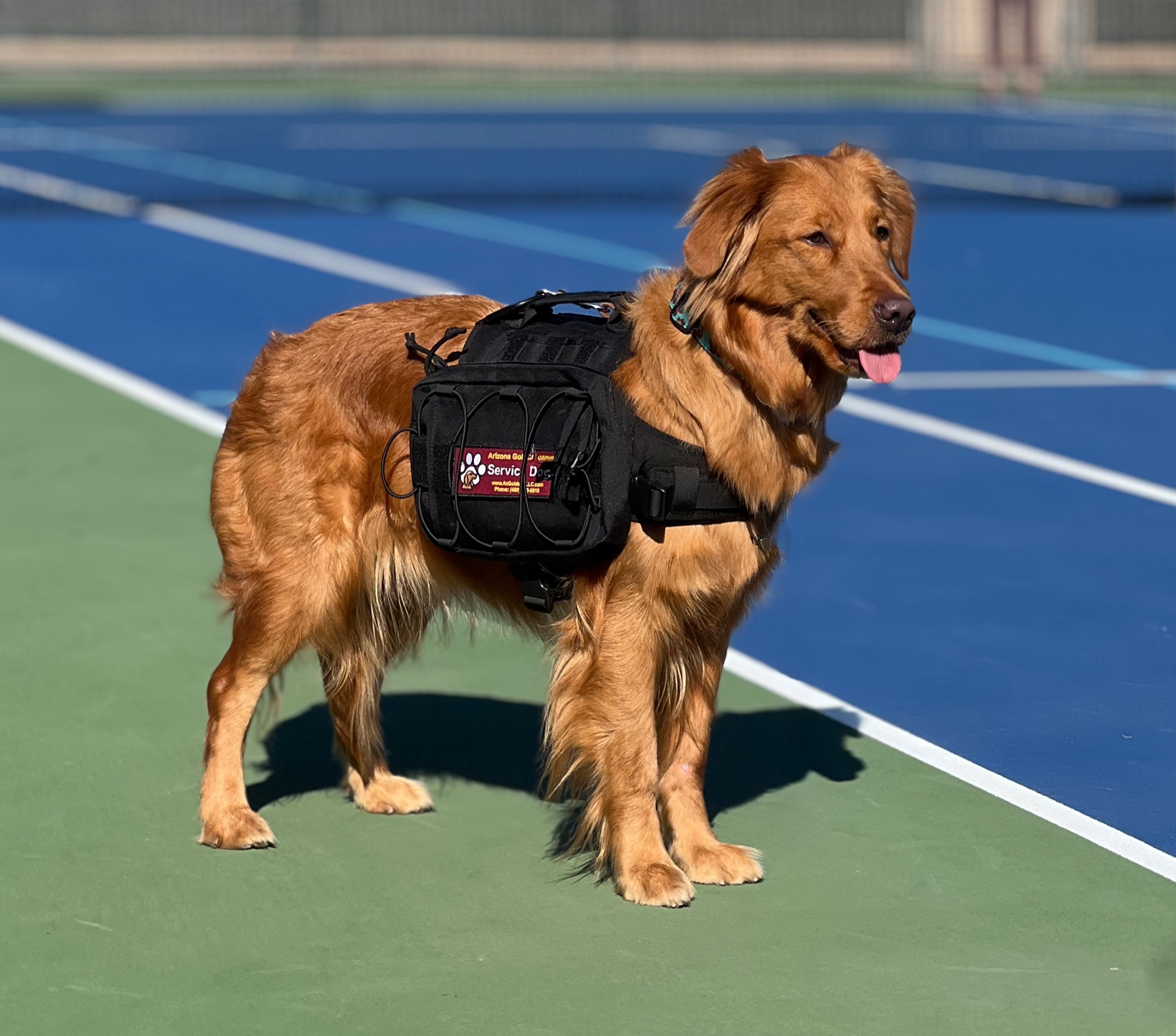
The work, task by task
POTS and syncope work runs on the same architecture as all our medical alert training — a chain of recognition, verification, response, and recovery, built to your specific presentation. A classic-POTS handler needs a different build than someone with vasovagal syncope; a handler living alone needs a different chain than one with family home. Yours gets designed in the assessment.
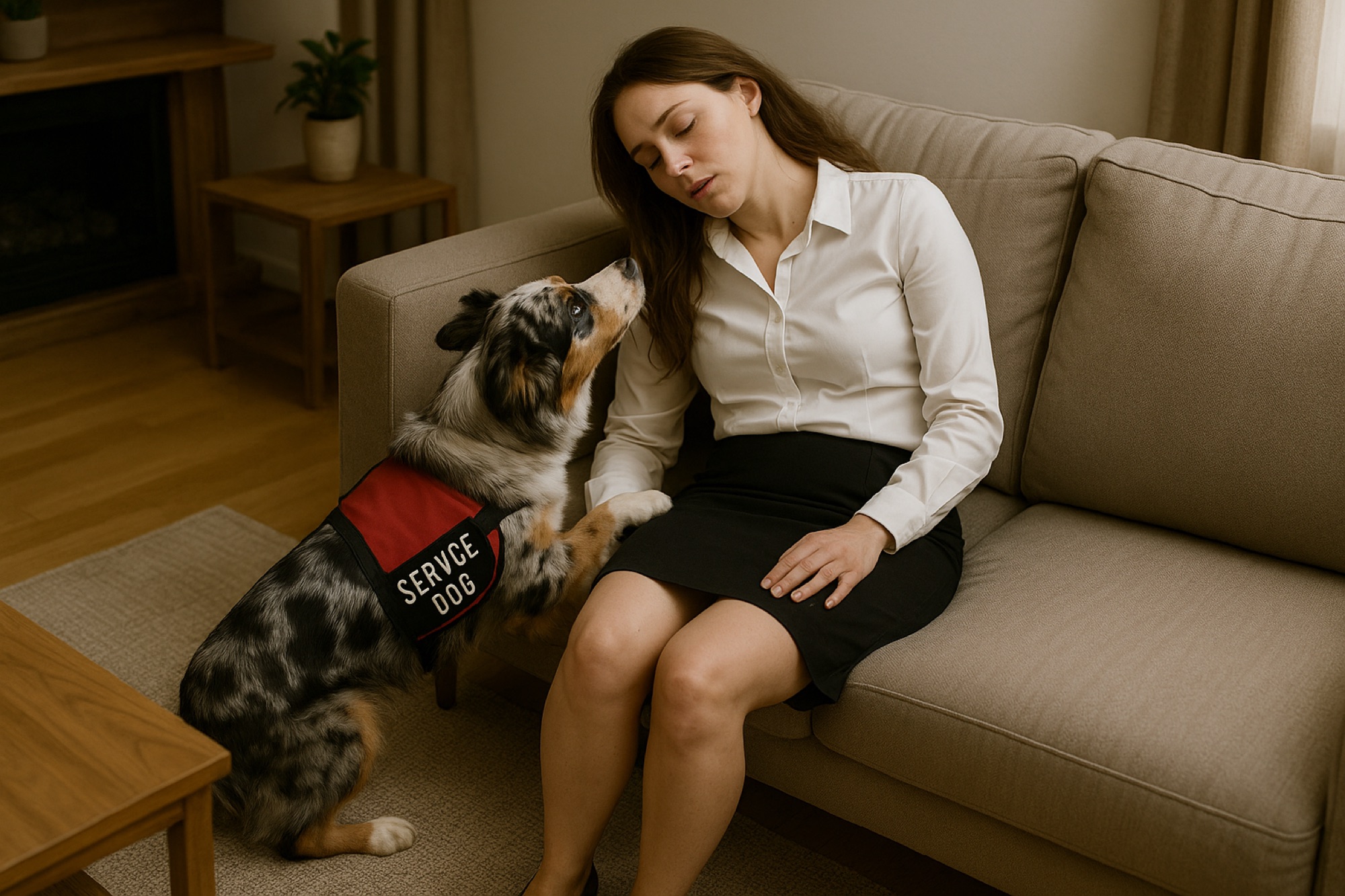
The dog learns your pre-episode signature — the changes at position transitions, the early signs of an episode building, and the breaks in your normal pattern that often show first — and responds in the opening seconds, often before you're consciously aware. And it verifies before escalating, so standing up fast or flopping on the couch doesn't trigger the full emergency chain. The longer you work together, the sharper this gets.
The response the moment matters most: signaling you to get low before the gray-out wins, then — if the episode is real — launching the help chain: hitting the medical alert button from anywhere in the home, or going to find a person and insisting. For handlers who live alone, the button branch leads, because the response can't depend on someone happening to be nearby.
When you're on the floor waiting for your body to reboot, the things you need are always in another room. The dog retrieves your pre-positioned supply pouch and water from set locations on command — your prescribed medications and your written action plan for anyone helping who doesn't know your protocol — so you never have to leave a safe position to get what you need.
During and after an episode, the dog applies trained, sustained pressure across your lap or torso — steady grounding weight through the worst minutes, in positions tailored to your presentation and your clinician's guidance during the assessment. Handlers describe it as the difference between riding an episode out alone on the floor and riding it out anchored.
POTS recovery is long and deceptive — you feel ready before your body is, and moving too soon is how one episode becomes two. The dog holds a Lay-On through the recovery window, braces as a stable support point when you do transfer, and stays with you until you're genuinely steady. The unglamorous work that prevents the falls and ER trips.
Built around your body
Here's something no other program we know of talks about: what happens when the handler's own training weeks collide with a condition that runs on good days and bad ones. Standard placement training is an intensive stretch of full days — which is exactly wrong for a body that punishes overexertion.
So for POTS and dysautonomia handlers, the same training happens on a paced schedule: lighter days spread over a longer window, adjusted day by day. Have a bad morning, and the plan flexes around it instead of plowing through it. The training was designed by people who've spent decades watching what these conditions actually do to a week.
And if what you need is a guarantee no dog can honestly offer, we'll say so at the evaluation, plainly and early.
How to vet any program — including usGetting started
No sales pitch, no obligation. We'd rather educate you than sell you — this is a working session from the first call. Each step links straight to where it happens.
Phone or Zoom with an experienced Service Dog Coach. Bring every question you have — including the hard ones.
Book your free call →An in-depth evaluation of disability profile, lifestyle, and needs — breed, temperament, drive level, tasks, and program fit. Every training plan starts here.
Start the assessment →A trainer and a dog-in-training come to you for a 90-minute working session — we evaluate the fit, you experience the methodology. Required for Premier.
How the visit works →The Service Dog School can start immediately — no waitlist. Premier and Foundations begin as your match comes together.
See the programs →Proof, not promises
When we began POTS work, medical alert dogs of any kind were rare and we knew of no one else training for POTS at all. The approach we built then is the one now echoed across the field: recognition and response, honestly framed. The research on medical alert placements reports what our handlers describe — independence coming back, episode aftermath getting safer, and the constant calculus finally quieting down.
The math on waiting
Another year of the constant calculus — the stairs you avoid, the errands you don't run alone, the driving you gave up — costs independence that never appears on a statement.
Worth knowing: our pre-trained dogs are almost always spoken for, so most handlers' dogs are raised for them — about 12 to 14 months of training that starts the day you commit. The toolkit is free and takes two minutes.
Straight answers
That's exactly the gap this training targets. Your body broadcasts changes before you consciously register them — at position transitions, in the minutes before a faint — and a dog trained on your specific pattern reads those signals and the breaks in your normal rhythm. Honest limits apply: no dog catches every episode, and nobody should promise you that. What changes is that 'no warning' stops being the default.
The walls you've hit — minimum-years rules, children-only programs, service radiuses — aren't how we decide. Our question is whether a trained dog can make you measurably safer and more independent, and whether your life can support a working dog. That's what the assessment answers, and plenty of our POTS handlers came to us after being turned away elsewhere.
Yes. We don't require you to rehome anything, and we match and train with your whole household in mind — cats included. For a lot of our handlers, the existing pet was non-negotiable, and it never needed to be negotiable. It's part of what the in-home interview evaluates.
That worry is exactly why the paced options exist. Placement training can run as lighter days over a longer window, adjusted to how your body is doing that morning — and the program paths differ in how much of the work lands on you at all. If today's answer is that you don't have the capacity, that's an honest conversation for the free call, not a reason to disqualify yourself before asking.
Service dogs have public access rights under the ADA, and that includes classrooms, dining halls, and campus housing — with the university's disability office handling the paperwork side. Campus life is also full of exactly the environments where the work matters: long walks, heat, crowded lectures, living away from family. We help you prepare the documentation and the dog arrives with public-access training built in.
Keep reading
More coming for this program
Free · 2 minutes · Built for your situation
Two minutes of questions, a toolkit built around POTS and cardiac work, and no sales pitch — ever. From the program that was here before the category had a name.
Three ways in
POTS handlers arrive at every energy level and every stage of diagnosis. The three paths flex around that — including training schedules paced to the condition on every one of them.
For handlers who need the full response chain arriving trained — especially those living alone, or whose episodes come without usable warning.
Learn moreThe path many POTS handlers choose: we build the recognition-and-response foundation, you finish with coaching, at a pace your body sets.
Learn moreFor hands-on handlers building their own dog with the response-chain methodology behind them — structured to flex around good days and bad.
Learn more