Premier Program
The primary path for guide work: the dog arrives with the full harness discipline built, and the partnership training happens with you, on your routes.
Learn moreGuide Dogs · The Most Specialized Track
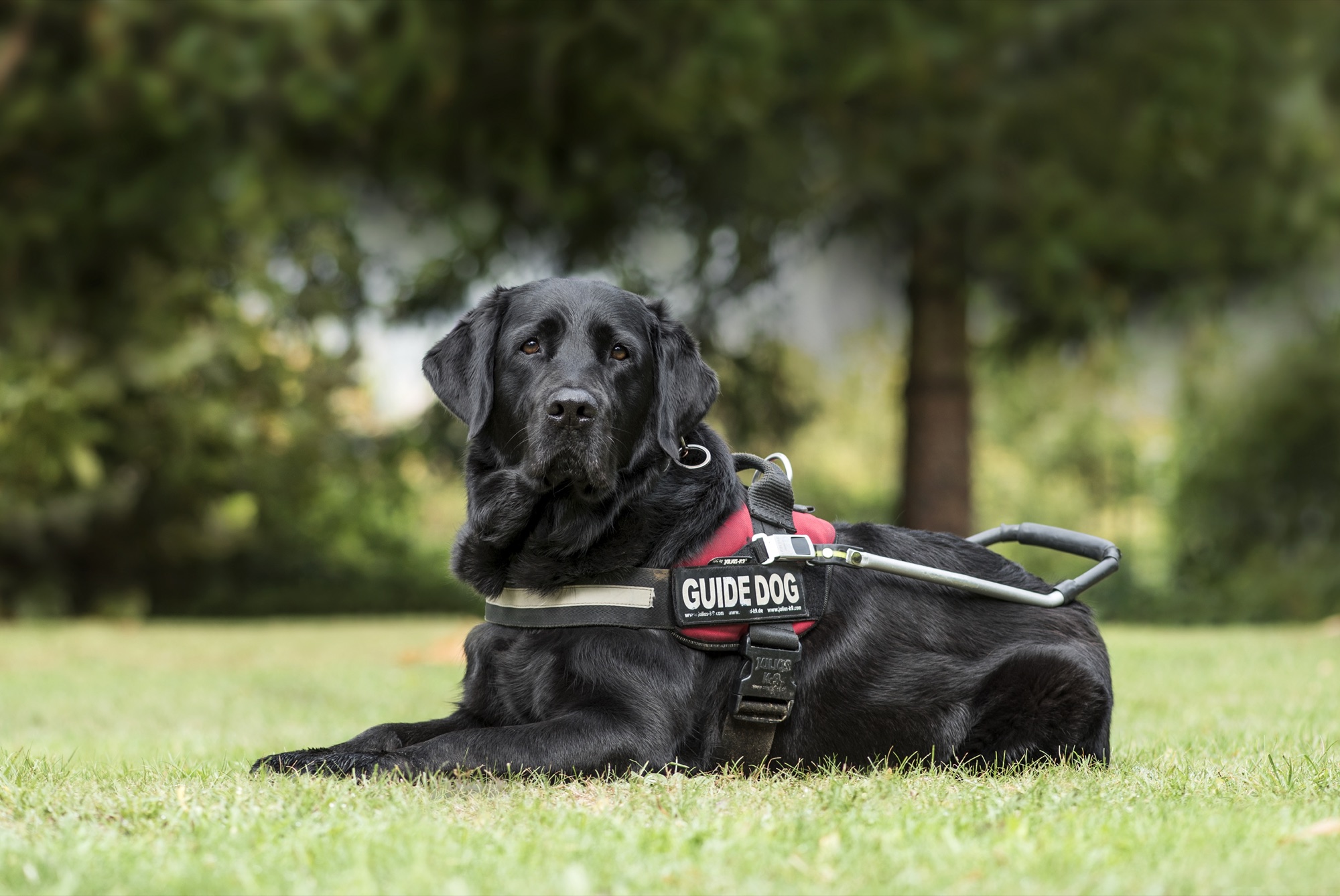
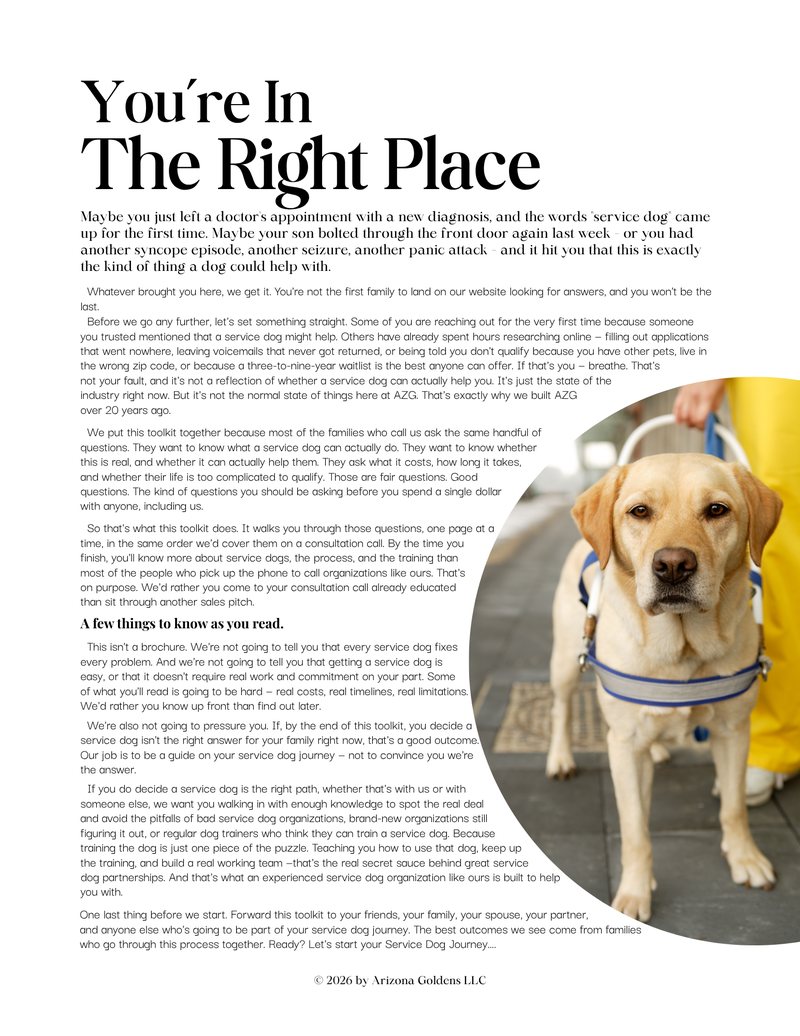
Guide work is a different paradigm from every other service dog job: you direct the route, the dog executes it safely — and refuses the command that would walk you into harm. It's the deepest, most specialized training in the field, with the least room for shortcuts. Here's the honest picture, including the parts that might point you to another program.
Arizona-based · Serving handlers nationwide
Guide work is its own paradigm: you hold the route, the dog makes each segment safe — and refuses the command that would put you in harm's way.
A different kind of partnership
Every other service dog track is built around a dog responding to what's happening to its person. Guide work inverts the relationship: the handler holds the route — the orientation, the destination, the mental map — and the dog's job is making each segment of it physically safe. Forward means forward, until forward would mean a car, a drop-off, or a low-hanging branch at face height.
That veto is the heart of the work. A guide dog is trained to disobey a command that would endanger you — to plant, hold, and refuse until the danger passes. Trainers call it intelligent disobedience, and it's the single hardest thing to build into a dog, because it asks for both total reliability and independent judgment in the same animal.
It also means a guide dog is not a navigation system. It doesn't know where the pharmacy is. The partnership works when a handler with solid orientation and mobility skills supplies the where, and the dog supplies the safely. That division of labor is the first thing to understand about this track — and the first thing we'll talk about on a call.
The work, task by task
Guide work is one integrated discipline rather than a menu, but it decomposes into trained components — each built to reliability, then woven into the moving partnership. These are the core five.
The dog navigates you around obstacles at ground level and — the part people don't expect — accounts for clearance at your head height, not just its own. Sign posts, open truck gates, low branches: the dog learns to treat your body as the thing being steered, threading a path that's safe for a person, not a dog.
The dog halts squarely at every elevation change — curbs, stairs up and down, platform edges, ramps — and holds until you've found the edge and given the next command. Each stop is information delivered through the harness: something is here, and it's yours to assess.
Between decisions, the dog holds clean lines — down a sidewalk, across an intersection without drifting — and on command targets the useful things: the door, the empty seat, the counter, the elevator button, the crossing pole. Targeting turns an unfamiliar space from a wall of unknowns into a set of findable landmarks.
At crossings the dog holds position while you make the go decision from sound and judgment — and then watches the physical picture as you cross, adjusting or stopping for the turning car you can't see. Traffic work is where guide training's reliability standard is at its most absolute, because the margin for error is zero.
The crown of guide work: the trained refusal. Commanded forward into a gap the dog judges unsafe — an oncoming car, a missing curb cut, construction where the sidewalk should be — the dog plants and disobeys until the danger passes. Trust in the refusal is trust in the partnership; it's the reason guide teams train longer than any other kind.
The candor you won't hear elsewhere
Here's the sentence a paid program isn't supposed to say: the major guide dog schools place dogs at little or no cost to the handler, funded by donors — and for many blind and low-vision handlers, one of those programs is the right choice. If their eligibility, timeline, and model fit your life, take that seat. We'll still be here if it doesn't.
Where a paid, individual program earns its place is everything around the edges of the big-program model: eligibility walls, multi-year waits, the desire to keep your other pets, training built around your specific routes and life rather than a campus curriculum, and full ownership of your dog from day one.
Guide work is also the track where we most insist on the free 20-minute call before anything else — because whether this path fits you depends on your orientation and mobility foundation, your daily routes, and your goals, and that's a conversation, not a form.
How to vet any program — including usGetting started
No sales pitch, no obligation. We'd rather educate you than sell you — this is a working session from the first call. Each step links straight to where it happens.
Phone or Zoom with an experienced Service Dog Coach. Bring every question you have — including the hard ones.
Book your free call →An in-depth evaluation of disability profile, lifestyle, and needs — breed, temperament, drive level, tasks, and program fit. Every training plan starts here.
Start the assessment →A trainer and a dog-in-training come to you for a 90-minute working session — we evaluate the fit, you experience the methodology. Required for Premier.
How the visit works →The Service Dog School can start immediately — no waitlist. Premier and Foundations begin as your match comes together.
See the programs →Proof, not promises
Guide dogs are the oldest and most studied service dog discipline — the model every other track descends from. The research record is consistent: matched, well-trained guide teams report greater travel confidence, more independent trips, and wider daily range. The discipline's own history also carries the honest caveat we'd tell you anyway: outcomes ride on the match and on the handler's orientation and mobility foundation, which is why screening and honest fit conversations matter more here than anywhere.
The math on waiting
Guide teams take the longest to build in this field, so a year spent deciding is a year the training hasn't started. That is the real cost of waiting here — and if a donor-funded school fits your life better, take that seat instead.
Worth knowing: our pre-trained dogs are almost always spoken for, so most handlers' dogs are raised for them — about 12 to 14 months of training that starts the day you commit. The toolkit is free and takes two minutes.
Straight answers
The trained refusal of an unsafe command. Commanded forward when forward means an oncoming car or a drop-off, the dog plants and holds until the danger passes. It's the defining skill of guide work — the dog obeys you absolutely, except when obeying would hurt you — and building both halves of that into one animal is why guide training is the longest and most exacting in the field.
Neither, honestly. The dog replaces the cane's obstacle-finding in most settings and adds judgment a cane can't offer, but many handlers still carry a cane for specific situations — and your orientation and mobility skills remain the foundation the whole partnership stands on. A guide dog amplifies a skilled traveler; it can't substitute for the skills themselves.
Often, yes — donor funding lets the major schools place dogs at little or no cost, and if their model fits you, that may genuinely be your best path. What a paid, individual program offers is what the big-school model can't: no multi-year wait, no eligibility walls, your other pets welcome, training on your actual routes, and a dog you own outright from day one. We'd rather lay that choice out honestly than pretend the free seats don't exist.
Calm, structurally sound retrievers dominate guide work worldwide for good reason — temperament stability under pressure is everything. Screening is the strictest in the field: eye evaluations and hip clearances are non-negotiable, on top of the full veterinarian-signed health report every placement here already carries. A guide dog with compromised vision or joints isn't a lesser guide dog; it's not a guide dog.
Low-vision handlers make excellent guide teams — the dog covers exactly the gaps that fluctuating or partial vision leaves: night travel, glare, depth judgment at curbs and stairs, the obstacle that appears on the bad-contrast day. The fit question is about your travel patterns and goals, not about meeting some threshold of blindness. That's a conversation for the free call.
Keep reading
More coming for this program
Free · 2 minutes · Built for your situation
Guide work is the track where fit matters most. Twenty minutes on the phone will tell you more than any page — including whether we're the right program for you at all.
Three ways in
Guide work's reliability standard shapes the paths differently than any other track — the deep harness work belongs with professionals, and the handler's part is learned, not improvised.
The primary path for guide work: the dog arrives with the full harness discipline built, and the partnership training happens with you, on your routes.
Learn moreFor handlers who want the foundation and early guide work built professionally, then to finish the partnership under close coaching.
Learn moreFor hands-on handlers building companion-level skills and structure first — with honest guidance about where owner-training stops and professional harness work must take over.
Learn more