
Premier Program
For handlers who need the full task set working from day one, on a dog whose size and structure were chosen for their specific body and equipment.
Learn moreMobility Assistance Dogs · Since 2006
For the thousand small moments a mobility impairment turns hard — standing up from a deep chair, the phone on the floor, the long walk from the car. A mobility assistance dog gives those moments back: a living brace point, a retrieval partner, a second set of hands that's always there. And we'll be straight with you about the physics, because this is the corner of the industry with the most overpromising in it.
Arizona-based · Serving handlers nationwide
Mobility impairment takes independence one “not today” at a time. We train dogs that give those moments back — the brace, the retrieve, the door you open yourself.
The real problem
Mobility impairment rarely takes independence in one dramatic moment. It takes it in accumulation — the errand that waits until your spouse is home, the coffee you don't say yes to because someone would have to drive and help and stay close, the store you stop going to because the parking is too far from the door.
The hard part isn't any single thing you can't do. It's that so much of ordinary life starts requiring another person to be available, willing, and physically present. The world doesn't close all at once. It closes one not today, I don't have help at a time.
A working mobility dog reverses that arithmetic. The door gets opened, the dropped thing gets picked up, the brace point is right there at your knee — and you go when you want to go, on your schedule, without waiting for anyone. The dependence doesn't vanish. It shrinks until your days belong to you again.
The work, task by task
These come straight from our mobility training manuals — the tasks we actually train, ranked by what handlers need first. Which of them your dog carries, and how far each goes, depends on your body, your equipment, and your dog's size and structure — that's what the assessment maps.
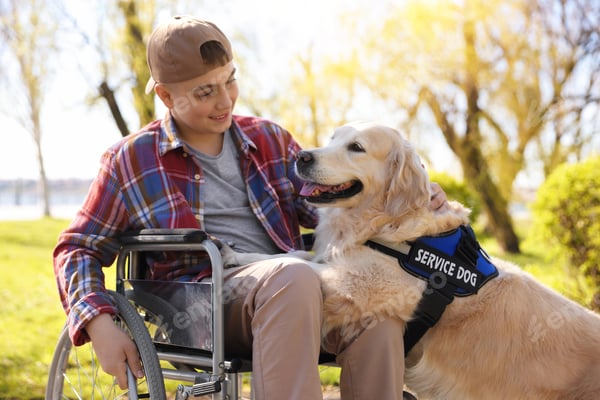
On the Brace command, the dog lowers into a stable stance with weight distributed evenly and holds completely still — a living grab bar the handler can push against to rise from a deep couch, a low chair, or the floor itself after a fall. Unlike the rail on a wall, this one walks beside you, matches your pace, and stays through the whole transfer.
For handlers whose balance is unreliable, the dog works alongside as a counterbalance partner — through doorways, down long hallways, across uneven ground. On stairs and ramps the work inverts: steady resistance to lean into going down, forward power to draw on going up. The dog also learns to coordinate around a cane, walker, or crutches rather than compete with them.
Dropped phones, keys off tile, medication bottles, the item on the shelf you can't reach, the things that fall into the dead space beside the wheelchair. Each texture and weight is its own training problem, and we train them individually. Honesty from our own manual: retrieval is high-percentage work, not perfect — a program promising 100% accuracy is selling marketing, not a dog.
Opening and closing doors and drawers with a tug strap, pressing elevator buttons and accessible-door plates, working light switches. Small tasks with outsized weight, because they're the difference between a route you can take alone and one you can't.
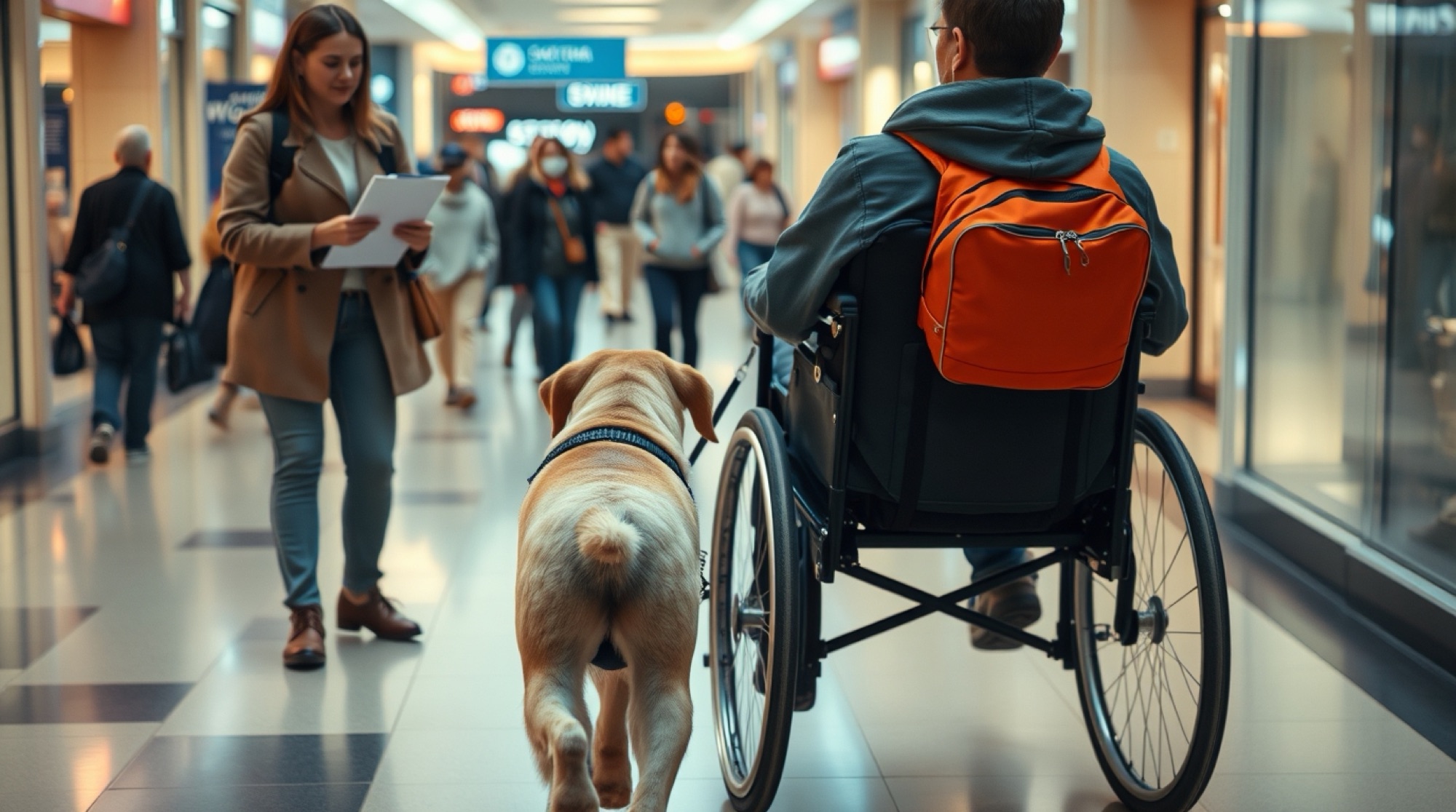
For wheelchair users, the partnership has its own vocabulary: pulling the chair up an incline, adding drag on a descent, helping with positioning in tight spaces, retrieving from ground level, and carrying what hands occupied with wheels can't. The dog is trained around your specific chair and your specific routes.
Before you spend a dollar
Mobility work attracts the biggest marketing claims in the service dog world — dogs that catch falls, replace walkers, carry any weight. Families sign contracts on those promises and meet the real-world limits after placement, when it's too late to un-spend the money.
Here's how we work instead. Your dog's physical tasks are scoped to a weight ratio that's safe for the dog and genuinely useful to you, matched to a dog whose size, structure, and joints have been evaluated for exactly this work. What we promise is written down, trained to reliability, and demonstrated in front of you before the partnership is yours.
And if what your body needs is more than a dog can honestly provide — some situations are — we'll tell you at the evaluation, plainly and early.
How to vet any program — including usGetting started
No sales pitch, no obligation. We'd rather educate you than sell you — this is a working session from the first call. Each step links straight to where it happens.
Phone or Zoom with an experienced Service Dog Coach. Bring every question you have — including the hard ones.
Book your free call →An in-depth evaluation of disability profile, lifestyle, and needs — breed, temperament, drive level, tasks, and program fit. Every training plan starts here.
Start the assessment →A trainer and a dog-in-training come to you for a 90-minute working session — we evaluate the fit, you experience the methodology. Required for Premier.
How the visit works →The Service Dog School can start immediately — no waitlist. Premier and Foundations begin as your match comes together.
See the programs →Proof, not promises
“Our clients can accomplish some of the daily tasks that may seem impossible before — thus leading a more independent life.”
From AZG's Mobility Assistance program film
Independent research on mobility assistance placements points the same direction: handlers report significant gains in independence and daily function, and households report needing meaningfully less outside help. No study calls the dog a replacement for medical equipment or clinical care — and neither do we. The honest claim is narrower and better: the thousand small moments come back.
The math on waiting
Every errand that waits on someone else's schedule, every invitation declined over logistics — a year of that adds up to a life run on other people's availability.
Worth knowing: our pre-trained dogs are almost always spoken for, so most handlers' dogs are raised for them — about 12 to 14 months of training that starts the day you commit. The toolkit is free and takes two minutes.
Straight answers
No — and any program that says yes is one to walk away from. Brace and counterbalance work carry a portion of your weight within safe ratios for the dog's size and structure; they can't arrest a full fall or replace a weight-bearing device. What the trained work does is make transfers, walks, and recoveries dramatically safer and less dependent on another person. We'll scope what's realistic for your body and the right-sized dog at the assessment.
The chair changes the task list, not the value. Retrieval from the floor and shelves you can't reach, doors and buttons, carrying, help with inclines and descents, positioning in tight spaces — and everything social that comes with moving through the world beside a calm, working dog. The training is built around your specific chair, routes, and daily friction points.
Size and structure matter more here than in any other program. The dog has to be large and sound enough for its specific physical tasks, with joints evaluated for the work — which is why every placement is preceded by a veterinarian-signed health report that includes X-rays read for exactly these questions. It's also why load-bearing training waits for full skeletal maturity.
No — it works with them. The dog learns to move in coordination with your device: pacing beside a walker, keeping clear of a cane's arc, adding counterbalance where the device can't. Handlers often find they rely on the device less in some settings, but that's a bonus the partnership earns, never a promise we sell.
The task set isn't frozen on placement day. Dogs cross-train, and the coaching relationship continues — as your needs shift, the working repertoire can shift with them. That's also a conversation for the assessment: if your condition's trajectory is known, we plan the dog's training around where you're headed, not just where you are.
Often, yes. Mobility pairs with seizure response and psychiatric work regularly — it's some of the most common dual-training we build. The second job raises the training bar and narrows the field of suitable dogs, which the assessment sorts out honestly.
Keep reading
More coming for this program
Free · 2 minutes · Built for your situation
Two minutes of questions, a toolkit built around mobility work, and no sales pitch — ever. Including the physics nobody else puts in writing.
Three ways in
Mobility work shapes which path fits: the physical tasks need a size-matched, structurally sound dog and careful hands-on coaching. All three paths get you there.
For handlers who need the full task set working from day one, on a dog whose size and structure were chosen for their specific body and equipment.
Learn moreFor handlers who want the physical foundations — brace, retrieval, device coordination — built professionally, then to finish the daily-function work together.
Learn moreFor hands-on handlers building their own dog with our methodology and coaching — with the physical tasks scoped honestly to the dog you have.
Learn more